Category: Hiking around Vlatos

  • Feeding the vultures

    Feeding the vultures

    Could well be a movie title equivalent to Dances with wolves? Sure, if this was not the case that the co-owner and restorer of the medieval settlement that became Milia Mountain Retreat (a local “Green Man” in his overwhelming passion for Nature preservation and species protection), Giorgos Makrakis, wouldn’t put it in practice. Committed to practicing absolute recycling of resources, Giorgos often drives to the sloping sides of the mountains around Milia and disposes of organs and bones from dead animals on his farm, in order for the predator birds (vultures) that fly over him throughout his life to have a meal.
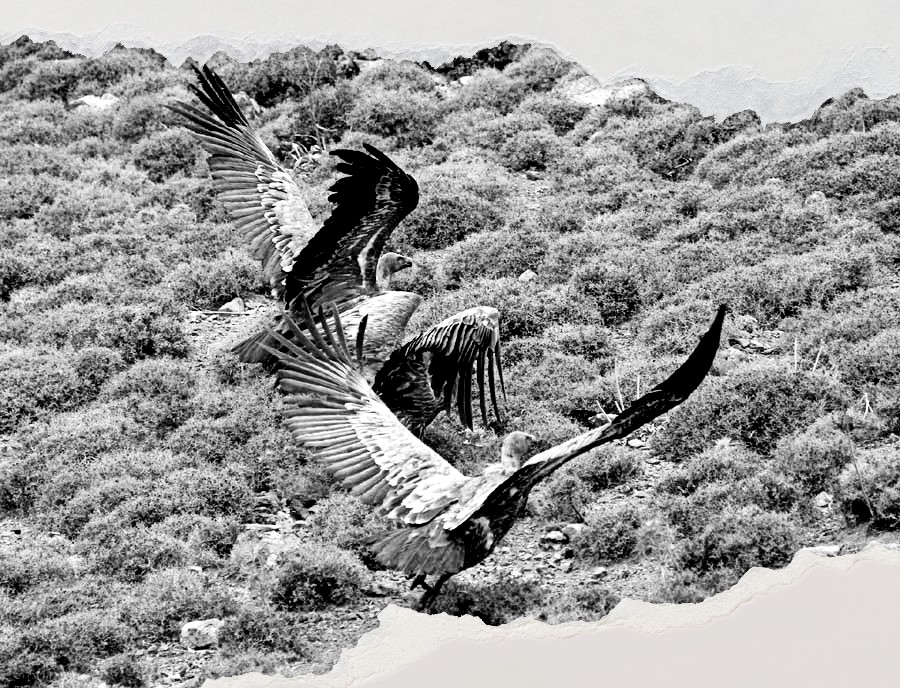
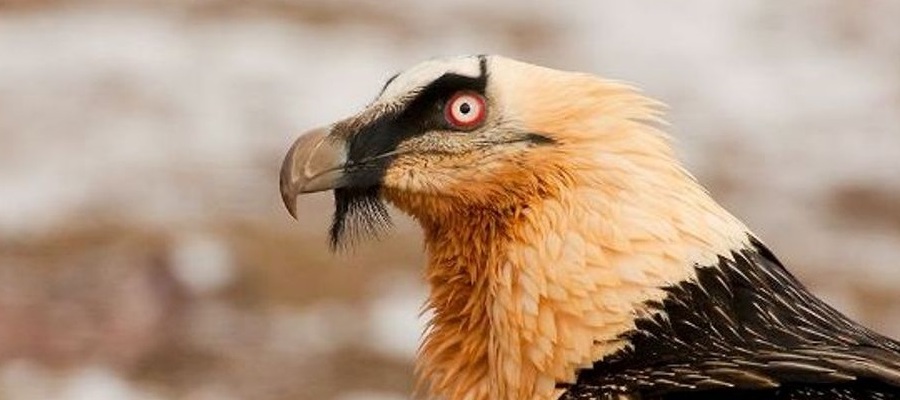
    Predator birds in Crete, vultures of two different kinds, the Gypaetus Barbatus and the Gyps Fulvus, are often seen over the sky of Milia, with the second being the most common species. The Gyps vulture has a wingspan of 260cm and a body length of around 97 – 104 cm, slightly smaller than its family, the Gypaetus, with 270 cm wingspan and body length ranging between 102 and 114 cm. 

    The “Gyps and Co” fly in smaller or larger groups, and their color can be distinguished easily with binoculars; the feathers of the collar are white short for an adult, who has a white-gray head and neck, brown to white-gray plumage. This species is known for only eating dead flesh, which practically means that it can rather cause awe than a threat, as it does not attack anything moving. 

    The bigger Gypaetus has an off-white head and chest, square wings, black back, and a long tail, is rare in the area and very difficult to reproduce. It is being fed exclusively by bones, thus the remaining part of the others’ meal, which practically means that Nature knows better in terms of recycling. 

    Unbelievable or adventurous as it may seem, the practice of feeding the vultures is for Giorgos not more important than cleaning an old stone fountain from its dirt, coming up with an owl’s nest, and placing it on a tree where she is seen to frequent, or rushing to unblock a goat’s horns that got trapped at the fence. Preserving natural and cultural elements alike, this persisting local is used to still be keeping old tree trunks found around Milia, wood that was once used for construction and is still strong enough for potential re-use, especially if it comes from amazingly smelling trees, such as cedars. 

    Don’t take him wrong, though, he will not drive you around for vulture feeding if you happen to visit Milia for a relaxing stay. Nor will he point out where these awe-inspiring birds (the “ornea” in Cretan dialect) frequent for the lunch that he provides them with. By now he knows, they never show up if anybody approaches out of curiosity or to take photos. It is a different deal they have with him, and it is about mutual respect, a kind of intimate relationship, and rare proximity. Thus they approach, yes, but only when he is alone. They even recognize his car.
  • The Chestnut Tree, a Perfect Winter Romance

    The Chestnut Tree, a Perfect Winter Romance

    There are no certain skills required to fall in love with a chestnut tree; she is audacious, classy, and casual at the same time, passively aggressive to enemies, and courageous, at the same time. She is a living miracle.

    As you are packing for your winter travel, space, weight and time are to be considered, but not when you are about to enter the chestnut forest of Milia, where space and time vanish. As it happens in every romance, that is worth being named as such. 

    So if you’re spending your winter vacation around the area of western Crete, get ready for the perfect winter love affair, that follows the hiking and sightseeing parts of your trip; the chestnut tree is your other half.

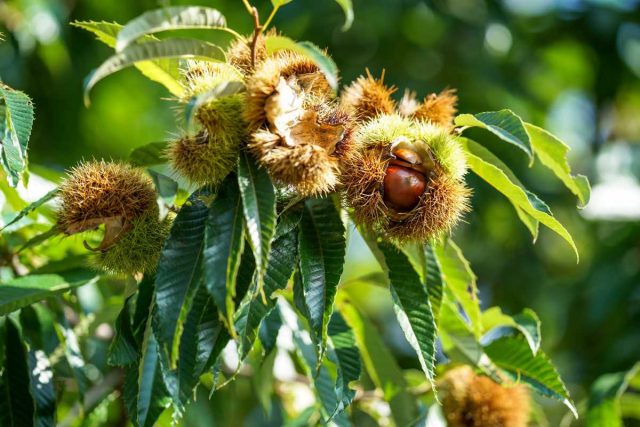
    The common chestnut (Castanea sativa) of the northern hemisphere, is widespread in the mountainous areas of western Crete, and gives edible fruits, a product that has long been a source of income to the locals -and to the inhabitants of Milia, as well, since the 16th century. It is a large tree with long leaves, which can reach a height of 30 m, although the average ranges from 12 to 15 m.

    What is poetic about her, is the fact that the “male” and “female” flowers are formed on the same plant, but separately, awaiting the proper touch of Nature in order to come together. Sounds like a fairytale, extracted from some previous centuries’ romantic literary genre? That and more, the “male” parts are united in upright florets and appear in July, whereas the “female” ones are born united in groups, at the ends of the branches, inside a spiny sheath. And, at some unexpected moment in late September and early October, we just eat her autumn fruits!

    Of the fruit-bearing varieties of this species, the most important are the “Chestnuts of Pelion” (in Central Greece) and the “Chestnuts of Crete”. The climate should be temperate and humid. It withstands the winter cold but needs a warm and sunny location to grow well, bloom, and complete the ripening of its fruits. It is pleasant to be thinking of the chestnut tree as your romantic relationship. You’ll typically need three layers to protect yourself from a winter cold or a bad romance; one to wick, one to insulate, and one to protect. But the chestnut tree is not of the kind. She is tender and comprehensive in her attitude, needs care, however. Are you willing to jeopardize your strong character and your attitude? She, too, has a shelter of spines. Take a lesson out of this relationship, no one is to be hurt if taken care of with respect and…slowly.

  • Hiking paths on Openstreetmap

    Hiking paths on Openstreetmap

    GPS is very unreliable in the Cretan mountains

    But never mind that we live under a big NATO bubble and hence the problems people face when using GPS on Crete. Nestled in the rugged Kissamos region of western Crete, the villages of Vlatos and Innachorio (also known as Inachori, now part of Kissamos municipality) offer a wealth of peaceful hiking (click here for more info about hiking around Vlatos) amid olive groves, chestnut forests, and dramatic mountain slopes at around 500–600 m elevation. These areas feature easy-to-moderate trails perfect for nature lovers seeking serene escapes rather than intense gorge descents.OpenStreetMap excels here as a free, community-updated resource with detailed trail mapping. View and explore paths directly on OpenStreetMap.org (search for “Vlatos, Kissamos, Crete” or zoom to coords ~35.39°N, 23.65°E). Key highlights include:

    • Park of Peace Trails (Vlatos outskirts): Interconnected easy loops (4–6 km total, 1–2 hours, <150 m elevation gain) through meadows, pines, and olive terraces—ideal for picnics and birdwatching. Well-marked and visible on OSM.
    • Vlatos to Milia Eco-Village: Moderate 5–7 km out-and-back (2–3 hours, ~200 m gain) along old mule paths to the sustainable chestnut-forest hamlet of Milia.
    • Vlatos to Elos Chestnut Trail: Easy-moderate 6 km linear path south into Innachorio, connecting to chestnut groves and village charm.
    • E4 European Long-Distance Path sections: The renowned E4 weaves through Innachorio’s landscape (traceable on OSM via waymarkedtrails.org or directly on OSM layers). Enjoy scenic village-to-village links and extensions toward Elafonisi’s iconic pink-sand beach (e.g., 12–15 km moderate coastal-mountain stretch from Livadia area westward).

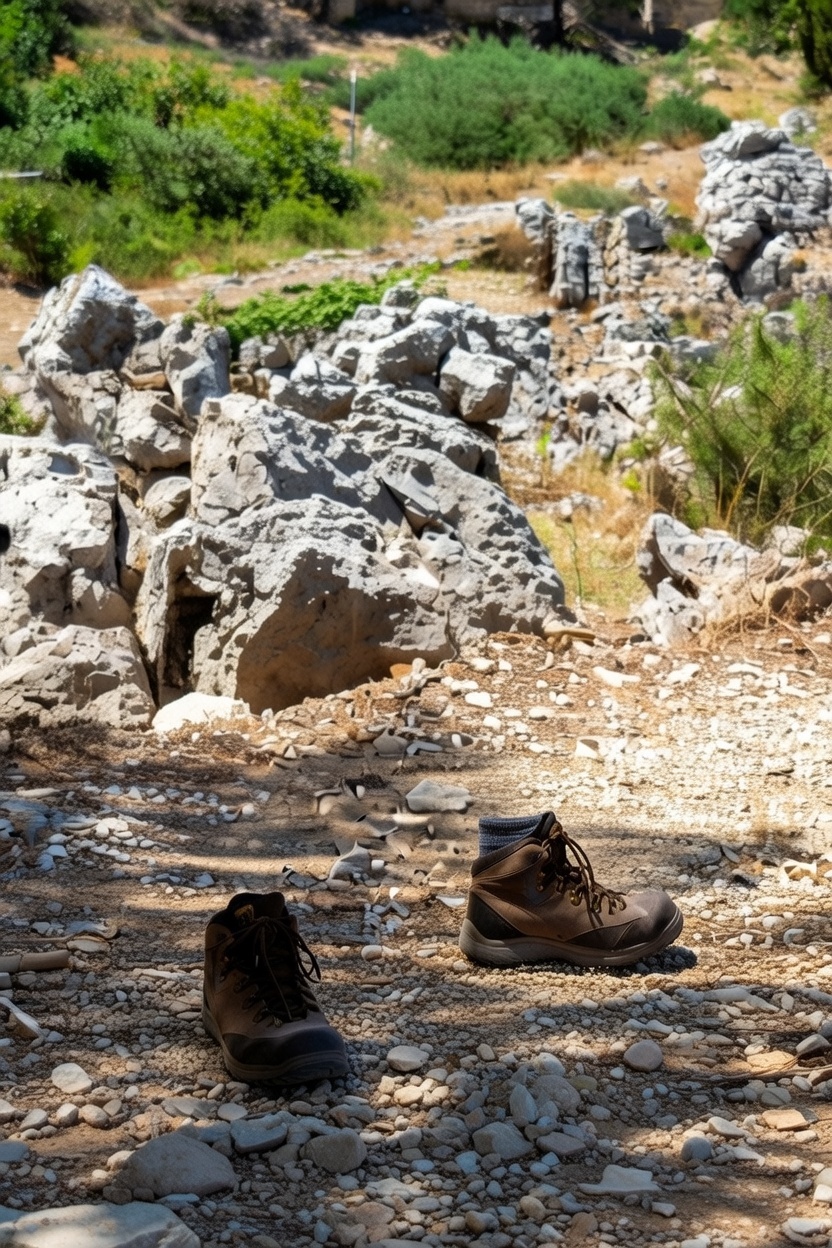
    October shines for visits, with mild 20–25°C temps and golden autumn foliage. Trails are generally well-marked but rocky in spots—wear sturdy shoes, carry water, and download OSM-based apps like OsmAnd (excellent offline maps & navigation) or Organic Maps for reliable routing without cell signal. For broader planning, cross-reference with AllTrails or Wikiloc, but OSM provides the most current, community-sourced detail for this authentic, off-the-beaten-path corner of Crete. Happy trails!


    View Larger Map