Could well be a movie title equivalent to Dances with wolves? Sure, if this was not the case that the co-owner and restorer of the medieval settlement that became Milia Mountain Retreat (a local “Green Man” in his overwhelming passion for Nature preservation and species protection), Giorgos Makrakis, wouldn’t put it in practice. Committed to practicing absolute recycling of resources, Giorgos often drives to the sloping sides of the mountains around Milia and disposes of organs and bones from dead animals on his farm, in order for the predator birds (vultures) that fly over him throughout his life to have a meal.
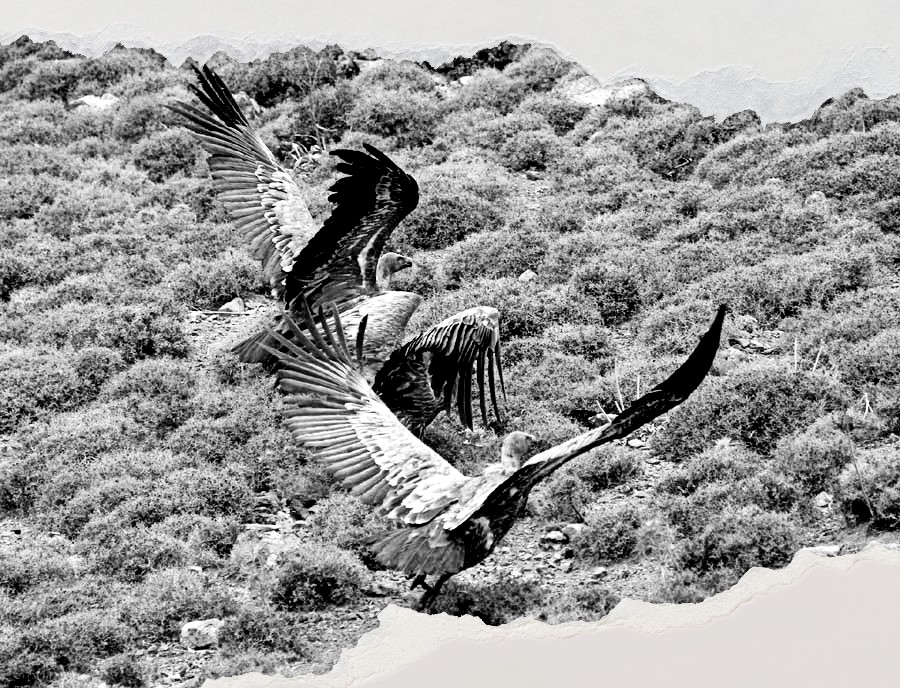
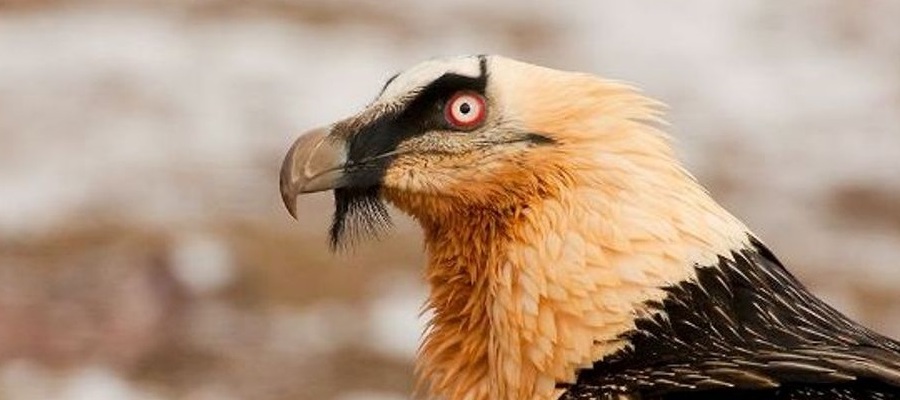
Predator birds in Crete, vultures of two different kinds, the Gypaetus Barbatus and the Gyps Fulvus, are often seen over the sky of Milia, with the second being the most common species. The Gyps vulture has a wingspan of 260cm and a body length of around 97 – 104 cm, slightly smaller than its family, the Gypaetus, with 270 cm wingspan and body length ranging between 102 and 114 cm.
The “Gyps and Co” fly in smaller or larger groups, and their color can be distinguished easily with binoculars; the feathers of the collar are white short for an adult, who has a white-gray head and neck, brown to white-gray plumage. This species is known for only eating dead flesh, which practically means that it can rather cause awe than a threat, as it does not attack anything moving.
The bigger Gypaetus has an off-white head and chest, square wings, black back, and a long tail, is rare in the area and very difficult to reproduce. It is being fed exclusively by bones, thus the remaining part of the others’ meal, which practically means that Nature knows better in terms of recycling.
Unbelievable or adventurous as it may seem, the practice of feeding the vultures is for Giorgos not more important than cleaning an old stone fountain from its dirt, coming up with an owl’s nest, and placing it on a tree where she is seen to frequent, or rushing to unblock a goat’s horns that got trapped at the fence. Preserving natural and cultural elements alike, this persisting local is used to still be keeping old tree trunks found around Milia, wood that was once used for construction and is still strong enough for potential re-use, especially if it comes from amazingly smelling trees, such as cedars.
Don’t take him wrong, though, he will not drive you around for vulture feeding if you happen to visit Milia for a relaxing stay. Nor will he point out where these awe-inspiring birds (the “ornea” in Cretan dialect) frequent for the lunch that he provides them with. By now he knows, they never show up if anybody approaches out of curiosity or to take photos. It is a different deal they have with him, and it is about mutual respect, a kind of intimate relationship, and rare proximity. Thus they approach, yes, but only when he is alone. They even recognize his car.