

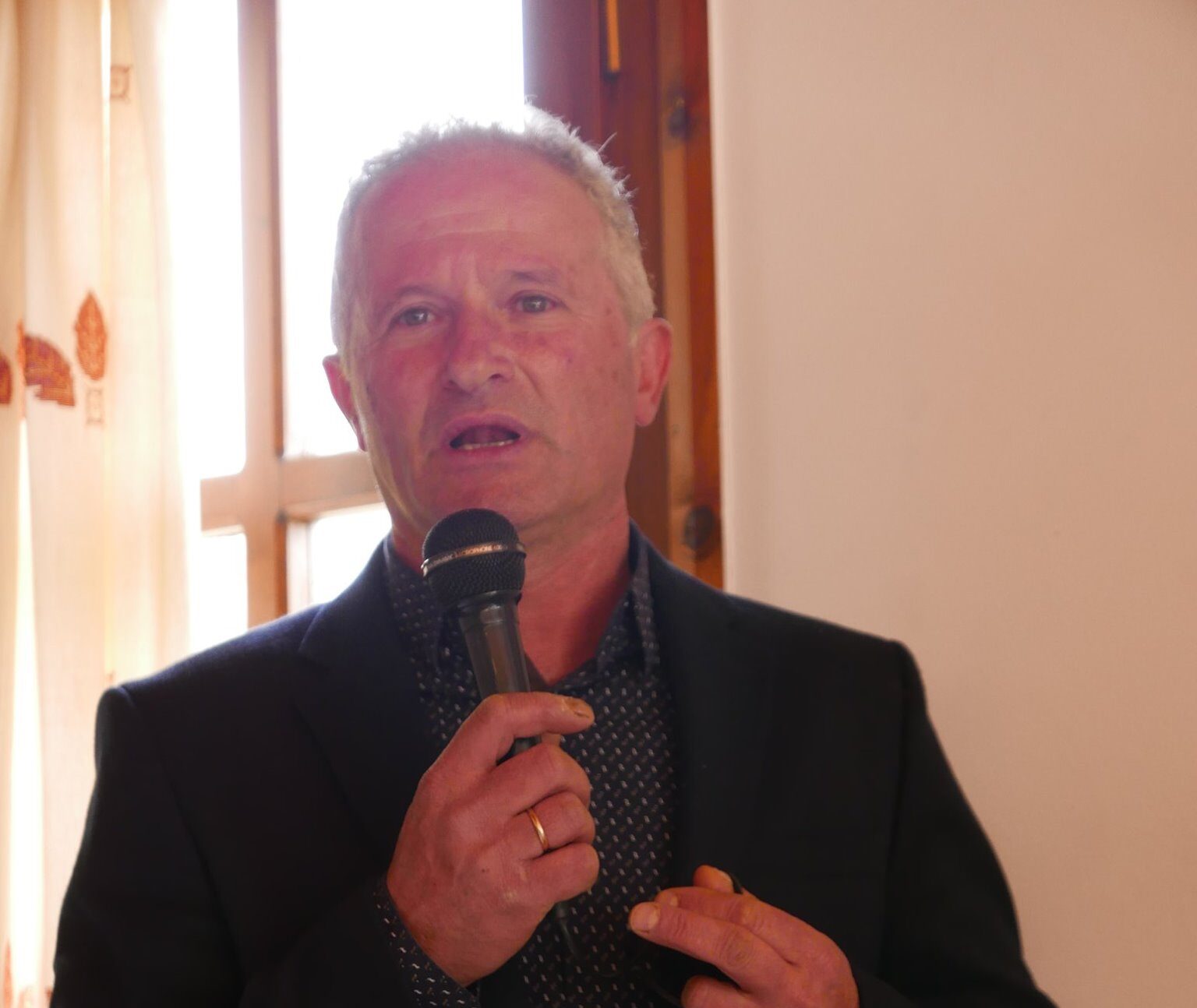
The story of George Makrakis is the story of a man who never left his mountain—and in staying, he helped the mountain itself come back to life.Born and raised in the stone embrace of Vlatos, under the same thyme-scented sky that still greets dawn with goat bells and distant sea whispers, George grew up surrounded by loving parents who taught him the quiet religion of hard work and reverence for the land. In the old village schoolhouse—now the Folklore Museum—he first met Kostas Koukourakis, a friendship that would one day grow into shared battles for the soul of Innachorio, the wider Kissamos region. Even as boys, they sensed the place held something sacred: not just earth and stone, but a way of living in harmony with both.
George became a builder in every sense. A strong believer in sustainable economy long before the term became fashionable, he poured his muscle, faith, and unyielding energy into reviving what others had forgotten. In the early 1980s, he met Jacob Tsourounakis (Iakovos), the visionary who dreamed of breathing life back into Milia—a 16th-century mountain settlement abandoned mid-20th century, its stone houses crumbling into the forest. Jacob brought the brains and the bold idea: restore the ruins, reforest the slopes, cultivate organically, create a small stock-farming unit, and open it to travelers who sought authentic connection with nature. George brought the hands—the relentless labor, the day-after-day grit of hauling stone, planting chestnut and pine, rebuilding walls by hand. Together they turned “kouzoulada” (Cretan madness) into miracle. After twelve years of exhaustive restoration, Milia Mountain Retreat opened in the early 1990s as one of the world’s first true eco-lodges. National Geographic named it a top ecolodge in 1998, praising it for family adventures, local culture, and environmental sensitivity in Western Crete’s mountainous heart. That reputation—earned through solar power, no electricity grid, organic gardens, and rooms faithful to Cretan mountain architecture—owes its strength to George’s tireless work. He was the muscle that made the dream stand.
He raised a beautiful family in Vlatos with his wife Artemis: three sons, Vasilis, Vangelis, and Rafail. Today, Vasilis carries the flame forward as chef of the Milia Restaurant, a rising star in Greece’s culinary scene, blending mountain herbs, local cheeses, and wild greens into dishes that taste like the land itself.George’s devotion never stopped at Milia. A deeply religious man, he held many roles in Vlatos’ Cultural Society “New Horizons,” quietly serving as guardian of tradition—tending the museum, supporting festivals, keeping the village’s heartbeat steady. He fought alongside the old mayor of Kastelli, Mr. Koukourakis (his schoolmate Kostas), for the sustainability of Innachorio: protecting gorges, forests, water sources, and the slow rhythm of rural life against hasty development. His belief was simple and fierce: the land gives if you give back.
Today, as vice-mayor of Kastelli (the municipal seat encompassing Kissamos and Vlatos), George oversees Tourism and Culture. He shapes policies that honor Crete’s heritage while inviting respectful visitors—always with an eye on balance, never exploitation.
To Martin Vlatos, George is more than friend or collaborator: he is best man, brother in spirit. When Martin arrived seeking quiet, George handed him the keys—not just to doors, but to possibility. He opened the 150-year-old stone church for those first unplugged acoustic evenings, and the old schoolhouse for ideas that would grow into the Vlatos Jazz Festival. In that act of trust, he planted the seed for music under candlelight, for strangers becoming family in a sacred space no bigger than fifty souls.
George Makrakis doesn’t speak of heroism. He lives it: in the calloused hands that rebuilt Milia, in the faith that guides his days, in the steady voice that still fights for the mountain’s future. He is the quiet force behind Vlatos’ peace—the man who stayed, worked, believed, and in doing so, kept an entire corner of Crete green, alive, and welcoming.If you walk the trails to Milia or sit in the church during a jazz set, you feel his presence: in the restored stones underfoot, in the organic meal on your plate, in the way the village still breathes easy. He built not for glory, but for tomorrow. And tomorrow, thanks to him, still looks a lot like yesterday—beautiful, rooted, sustainable.Welcome to his world. The mountain thanks him every day.